






No. 09 · Cre8tive AI · October 2026
Google's usual fix needed a thousand consenting visitors a day. I found the one that fits a small business.
Asked whether Google's Consent Mode could give Cre8tive AI's directors a fuller picture of their website traffic, I showed them its gap-filling couldn't work at their size, set out where Australian privacy law sits, ranked the alternatives, and recommended the one that needed nothing new: regional analytics, which I then built and put live.
- Result
- Australian visitors counted by default, with a clear notice and an opt-out, in the Google Analytics the business already had. Every other region still on opt-in, and earlier refusals honoured. The video player's tracking and cookie switched off on every video, and the privacy policy rewritten. No new service to pay for or run.
- My part
- The review, the recommendation, the seven-page report for the directors, and the build.
- When
- Report sent 18 October 2026; live on the website 21 October.
- Built with
- Google Analytics 4 and Google Tag Manager (Consent Mode's region-specific defaults), the site's own code and its video player's privacy settings; for the review, the Privacy Act, the regulator's guidance and Google's own documentation.
01 / 07
The question
Cre8tive AI's website launched in September on the most cautious setting there is: Google Analytics counted a visitor only after they clicked Accept. Anyone who clicked Decline, or just read the site without touching the banner, never showed up at all. So the numbers looked thin, and the directors asked the question a lot of small businesses ask: could Google's Consent Mode give them a fuller picture of the website, while staying on the right side of privacy rules?
02 / 07
What Consent Mode can and can't do
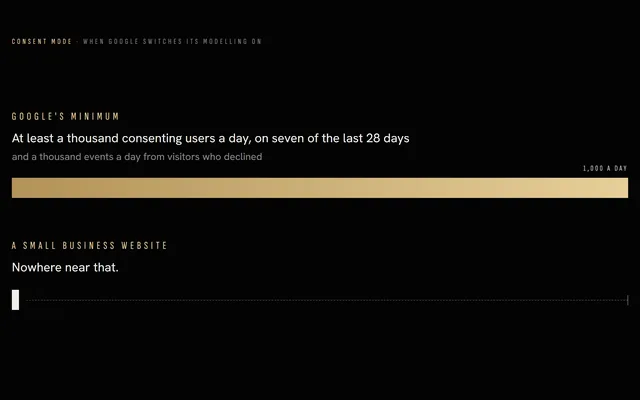
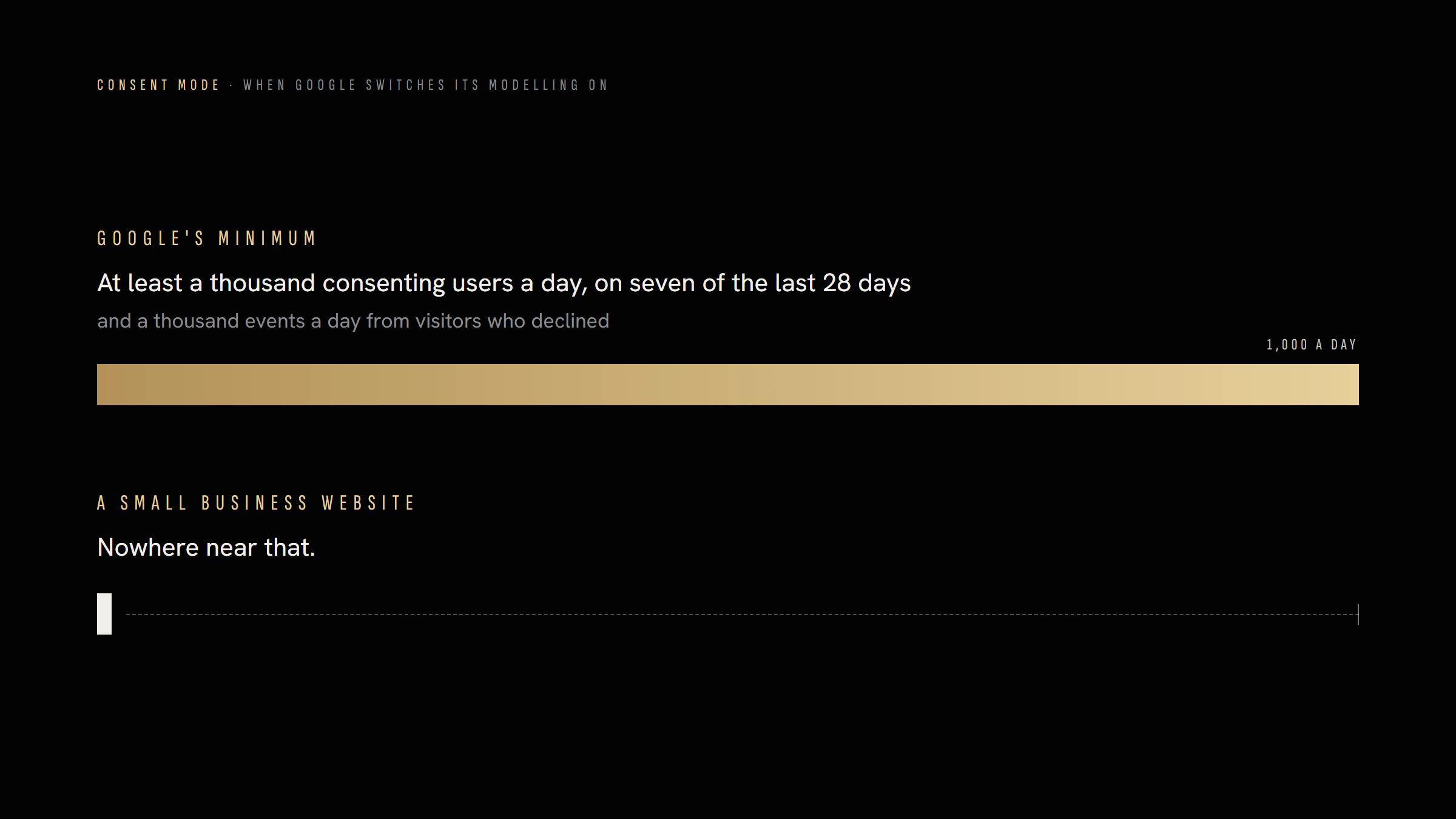
Consent Mode is often described as recovering the missing visitors. It does that by modelling: Google estimates how the people who didn't accept behave from the people who did, and fills the gaps in the standard reports. But Google only switches the modelling on for a site with at least a thousand consenting users a day, on seven of the last 28 days, and a thousand events a day from visitors who declined. A small business website is nowhere near that. Turning on the modelling would have changed nothing in the reports the directors read.
There was one genuine Google-only route: export the raw cookieless signals to BigQuery, Google's data warehouse, and build separate reports from them. I set out what that could count and what it couldn't, and it couldn't tell them how many people had visited.
03 / 07
Where the law sits
I went through the Privacy Act and the regulator's guidance. As the law stood in October 2026, Australia had no general rule that website analytics must wait for someone to click Accept. What decided it was whether the Privacy Act covered the business, whether what was collected was personal information, and what it was used for and who it was shared with. Most businesses with a turnover of $3 million or less weren't covered, but some were, through a related company, trading in personal information or a few narrower exceptions.
So I didn't ask the directors to claim an exemption. I designed the Australian setup to the standard a covered business has to meet anyway: collect only what's needed, set the tools to collect the minimum, tell people clearly what's collected and why, and keep the advertising features off. Visitors outside Australia were a separate question, and I covered it separately: Google's own consent policy for Europe, the UK and Switzerland, whether European law reaches the business at all, and the UK's new and narrow exception for analytics.
04 / 07
The alternatives, ranked
I ranked five options by how well each answered the directors' question, how much personal data it involved and how much it added to what the business runs: regional Google Analytics, a free cookieless counter from Cloudflare alongside it, Consent Mode with the BigQuery export, a privacy-first service such as Plausible, Simple Analytics or Umami, and a counter of our own.
Once I had confirmed the business's size and market, I recommended regional Google Analytics. The business sells to Australia, so Australian visitors are the ones whose behaviour shows whether the marketing works. Counting them properly, inside the property they already had, kept its history, its campaign tags and its enquiry tracking. Every other option meant a second set of numbers that would never match the first, and a second system to run.
What the review found that nobody asked about
On a fresh visit, before any choice on the banner, the browser already held a cookie from the site's video player: a cookie the player sets by default, part of its own viewer analytics. Google Analytics stayed blocked, as designed, but this sat outside the controls the site showed its visitors. And switching off the player's cookie on its own would have left its tracking running, because the two have separate settings.
06 / 07
The report
I wrote it up for the directors in seven pages, for two business owners rather than for lawyers or developers: the recommendation first, then what the site measured and what it didn't, what Consent Mode can and can't do, which rules apply, the alternatives ranked, what implementing it involves, and what no option can do. Past visits can't be recovered, no option counts every person, and the numbers before and after the change can't be read as one series. Eighteen sources, each one linked. Before anything went to the directors, I had an independent agent go back to the primary source behind each of the twelve claims the findings rested on.
07 / 07
Built and live
The directors approved both changes, and I built them. The part of Consent Mode that does fit a small business is its regional defaults, and that's what I built on. Australian visitors are now counted by default, with a short notice and an opt-out that takes effect straight away. Everyone else keeps the Accept and Decline banner, and anyone who had already declined stays out. A visit counts as Australian only when both the device's clock and Google's own location check say so. The video player's tracking and its cookie are off on all nine videos, and the privacy policy is rewritten and dated. I checked that every data-sharing and advertising setting on the analytics property was off.
Then I tested ten kinds of visit, on a local build and on the live site, and one more from a machine in Google's US data centre set to Brisbane time, to prove Google sends nothing when a visitor isn't really in Australia. The change date is marked in the reports, so the rise in numbers isn't read as growth.
The obvious answer was to switch on Consent Mode and let Google fill the gaps. At their size it would have filled none of them. The right answer was simpler, and it was already in the system they had.