



No. 07 · September to October 2026
I gave my AI agents full use of the professional film software on my PC. They rendered a client's film in Unreal Engine, and graded and mixed my own.
I built the tools that let my AI agents work inside the professional film and sound software I use (Blender, Unreal Engine, DaVinci Resolve, REAPER and SpectraLayers) through each app's own interfaces, in the background while I keep using my PC, and I direct and judge everything they make there.
- Result
- My agents work inside five professional apps through tools I built: Blender, Unreal Engine, DaVinci Resolve, REAPER and SpectraLayers, with iZotope RX both inside REAPER and on its own. They rendered a six-chapter explainer film in Unreal Engine for a client's new website, and they graded and mixed my short film What They Don't See, which is on my site. Since September my Claude and Codex agents have made more than 5,000 calls to these tools.
- My part
- All of it: the idea that my agents' computer use should be proper interfaces into each app; one way in to each app, with each vendor's own tools first; what every app had to let them do, up to everything I can do in my own editor; REAPER as the room where they mix; the build of the tools; and the direction of the films made with them.
- When
- From 7 September 2026, with Blender, Unreal and Resolve first; the client film approved on 8 October, its phone version on 11 October; REAPER, RX, SpectraLayers and Resolve's controls by name from 21 October; my film on my site from 23 October.
- Built with
- Each app's own interfaces: Blender's Python, Epic's own Unreal MCP with more than 800 tools, the DaVinci Resolve 21.1 scripting API and Resolve's on-screen controls reached by name, REAPER's ReaScript, and Windows UI Automation for SpectraLayers, which has no scripting interface. Over them, five MCP servers of my own with 172 tools, which my Claude, Codex and Gemini agents all use. Unreal Engine 5.8 (Lumen with hardware ray tracing, 16-bit EXR renders), Blender 5.2, DaVinci Resolve Studio 21.1, REAPER 7.83, iZotope RX 12, SpectraLayers Pro 13.
01 / 06
What computer use should mean
In early September 2026 I was working out what computer use should mean for my agents. The usual version has an agent look at the screen and click, and while it does, it has my PC: I can't work alongside it. I decided it should mean proper interfaces into the applications I want my agents working in, so they do the work through each app's own interfaces, in the background, while I keep using the same computer. A tool that does a job directly is also faster and surer than an agent hunting for it on screen. The screen stays for the few things no interface reaches. The same holds for any software a business runs on, and it's how I'd connect agents to it.
I started with Blender, Unreal Engine and DaVinci Resolve. In Resolve, where I edit, I wanted my agents able to take on the jobs I'd otherwise do by hand: the editor's, the sound designer's and the colourist's.
02 / 06
One way in to each app
At the end of September I had the first build reviewed and set two rules. Each vendor's own tools come first: Epic's own interface to Unreal, with more than 800 tools, and Blackmagic's scripting for Resolve, with mine built around them. And there's one way in to each app, so an agent can't end up on a lesser route without the full kit.
03 / 06
Built for real projects
An agent claims a project before it works on it, so two never edit the same one at once. Before an agent touches a Resolve project I have open, a restore point is saved. When a render runs longer than an agent waits, it checks on the render rather than starting it again, so nothing is rendered twice, and a heavy render waits until the PC has the memory for it. My own settings in each app are put back afterwards, or never touched at all.
04 / 06
A client's film, rendered in Unreal
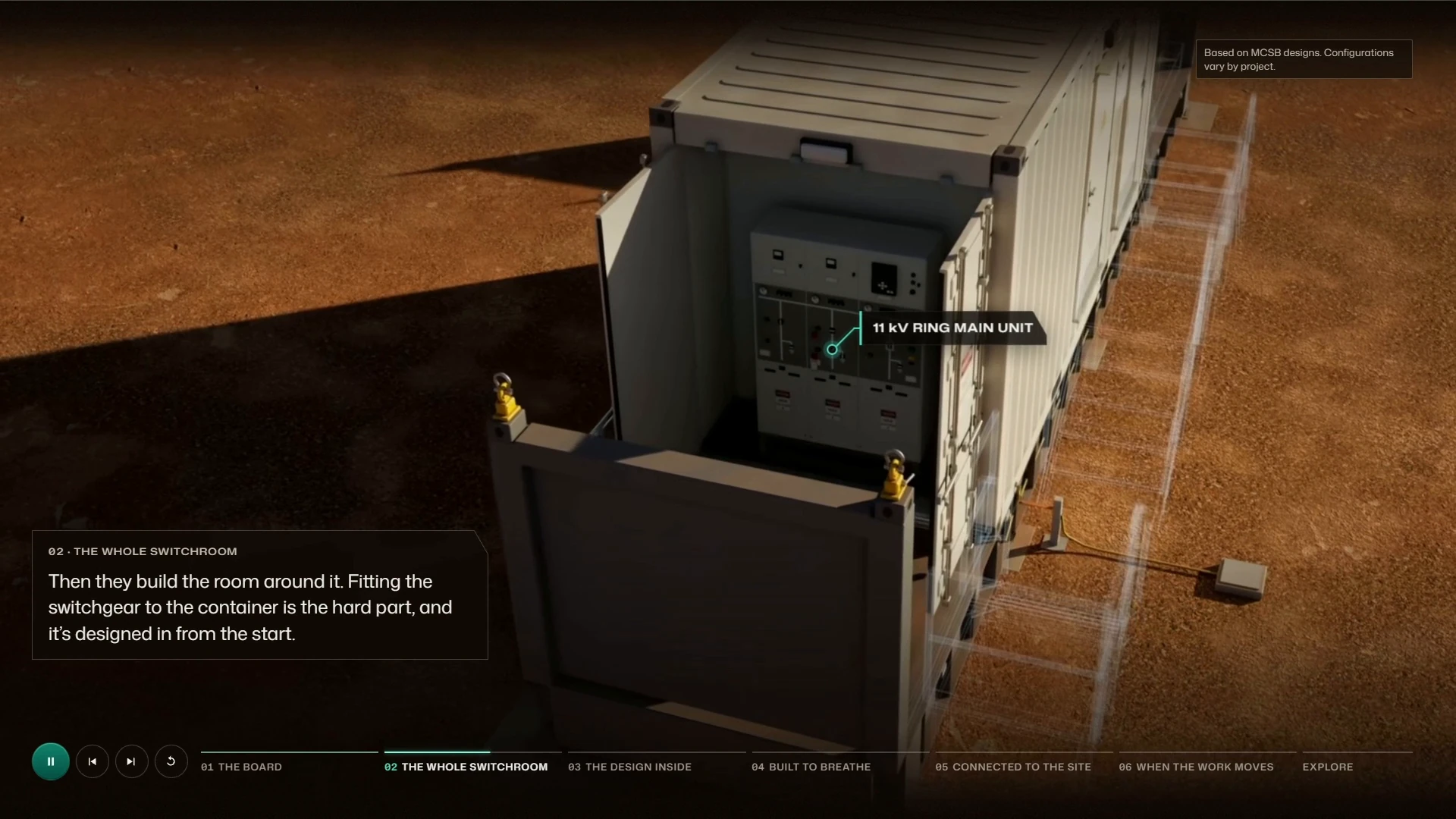
The first client job came in October. For Mission Critical Switchboards, an industrial switchboard maker, my agents built an explainer of one of their switchboards for their new website, as live 3D from a model they made in Blender. When I watched it, it still looked like toy town, and since it was mostly a film anyway, I asked why we didn't render it in Unreal Engine.
So my agents took the model from Blender into Unreal in one step and rebuilt the website's own timeline as Unreal's animation, so the labels on the page sit exactly on the film. Then they rendered it: six chapters, more than 17,000 frames across 133 render jobs, lit with Unreal's ray-traced lighting, and no render that started failed. I approved the film on 8 October and the phone version on 11 October. It's the most impressive thing I've seen come out of AI, and it made me a real believer in Unreal.

Everything I can do in my editor
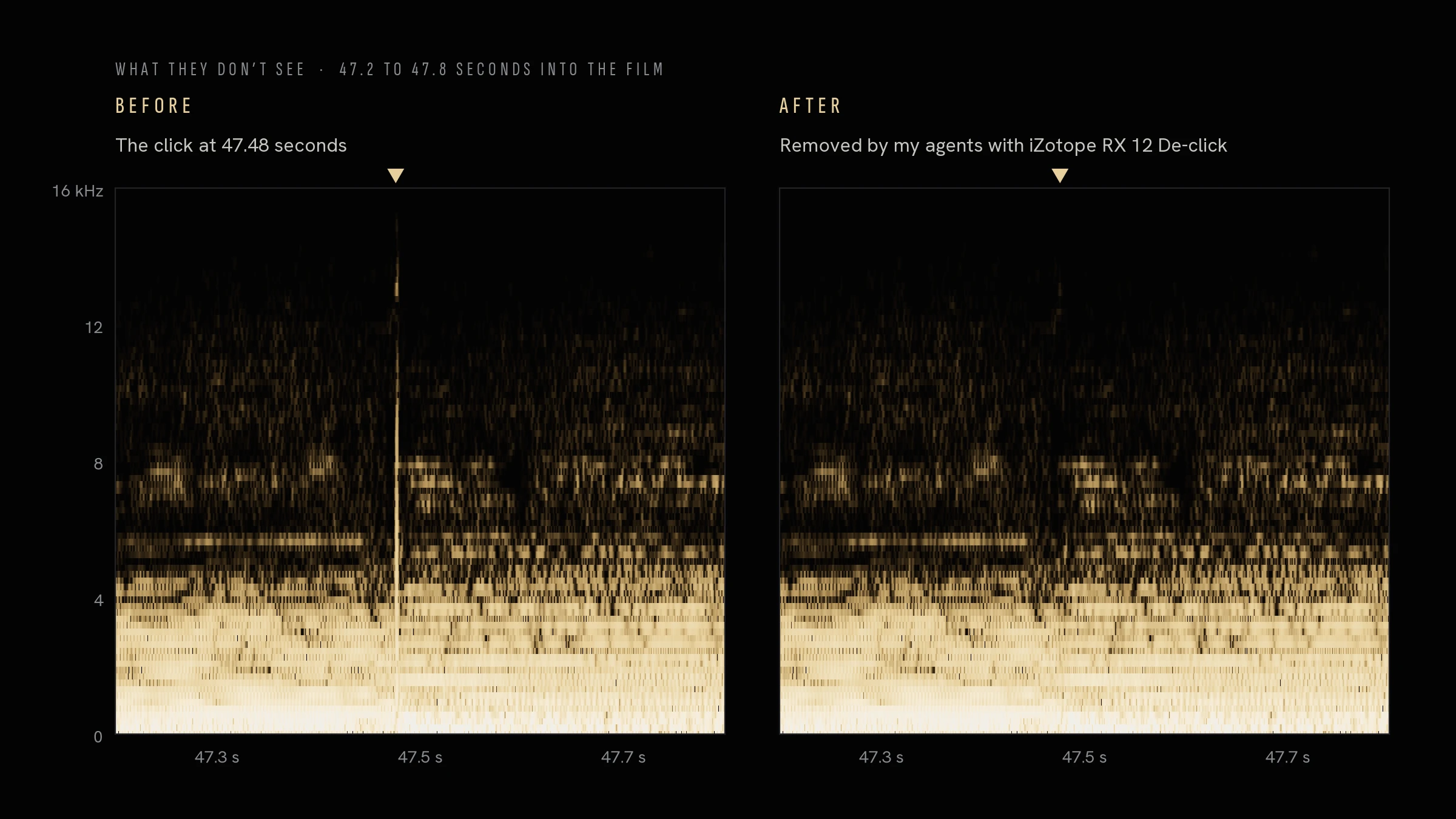
In October I tested two of my lead agents on the sound of my short film, What They Don't See: one on Claude Opus 5.5 and one on Gemini 4 Argon, with the same brief, and I judged their versions blind. Each lifted the hall's playing well past my own cut. But neither of them opened Fairlight, Resolve's sound page, or put a plugin on anything, and a click I'd heard at 47 seconds was still there.
The models weren't the problem. Between them they'd used only part of what I'd use myself. An agent is only as good as what it can reach, and if agents are going to work in the tools I edit with, they should be able to do everything I can do in them, and bring everything they know to it. So I stopped all film work until they could.
Then I built them the rest:
- REAPER, which I chose as the room where they mix. The cut comes over from Resolve, they build the mix with the plugins on my PC and automation, and the stems go back onto Resolve's sound page in line with the picture. Of the 278 plugins, 255 can be set by the value the plugin itself shows, and read back.
- iZotope RX 12 and SpectraLayers for repair. SpectraLayers has no scripting interface, so my tools work its own buttons and fields by name; RX's editor runs with no screen steps at all.
- Resolve by name. Where Resolve's scripting stops, my tools reach its controls by their names, so an agent sets a colour palette, a keyframe on an exact frame or a speed ramp the way an editor would, and writes looks as code with live sliders.
- The cut
- REAPER
- Resolve's sound page
06 / 06
The proof on my own film
The first proof was my own film. My agents took the version I'd liked best, put back my own edit from 22 to 27 seconds, retuned it to match, and took out the click with RX's De-click, opened only around the click itself. Everywhere else the sound is that version, identical to within a single bit. I listened on my phone: the parts I hadn't liked were covered, and I couldn't hear the click.
Then a lead agent finished the film for my site. I'd cut it myself. In Resolve it gave every shot a grade, with seven looks it wrote in code for the film's scenes, added grain and halation, and smoothed two joins; a second agent lifted the sound in REAPER and laid it back on Resolve's sound page. I chose the look, One light, in which the lamp she practises under becomes the spotlight she performs in. Then I chose a darker hall, and the details of the sound. I watched it full screen and dictated my notes. Every one was fixed, and I approved it as the master. It's on my site with the line I chose for it: I cut it myself, then directed its grade and sound mix through my own AI agents in DaVinci Resolve and REAPER.
If agents are going to work in the software a studio runs on, they should be able to do everything a person can do in it. Mine can, in the apps I use: they rendered a client's film in Unreal, and graded and mixed my own in Resolve and REAPER, while I decided what each film needed and whether it got there.