Newer work · Daily campaign report
A report that collects its numbers, checks them, writes itself and sends itself, every morning.
A campaign stopped without telling anyone, so I built Cre8tive AI's directors a daily report that makes sure nothing like that goes unseen again. It took a day, and it runs by itself.
- Result
- A four-page report in two directors' inboxes every morning, with nobody at the desk.
- My part
- All of it. The idea, the design of the system and of the report, and the build.
- When
- First edition sent 10 October 2026. Unattended from 12 October.
The report
A first page made by the report's own renderer on invented figures, since the real editions are for the directors. Every morning's edition opens this way: the headline numbers, each campaign side by side, and a plain-English read on what changed and what to watch.
Full size ↗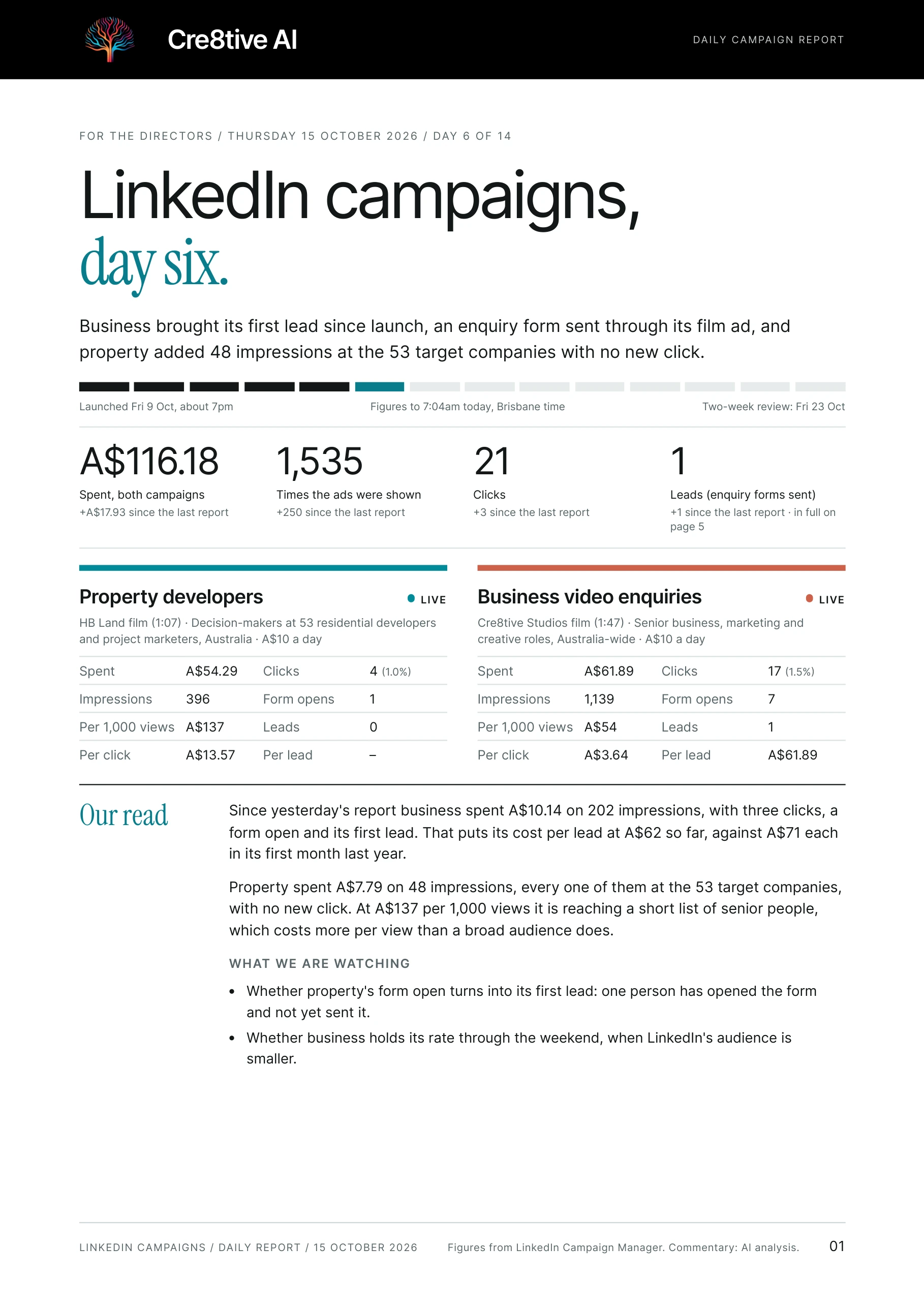
Where it came from
The directors wanted to know how their LinkedIn ad campaigns were going. As I was going through the campaigns, I discovered that one of them had paused. LinkedIn had stopped allowing the way it was set up, and it paused it without me getting a notification.
I got it up and running again, along with the second campaign. Then, to prevent things like this happening, I built an automation that tracks Campaign Manager every single day and emails the directors a report going over the analytics of each campaign and how everything is doing.
What I built, in a day
- Campaign Manager
- A second check
- An AI writes the analysis
- A four-page PDF
- Both directors
A report that makes itself. Each morning a script reads the campaigns' own figures. A second check compares every figure with what LinkedIn shows on screen, to the cent, before anything else happens. An AI writes the analysis in plain English: what was spent, who saw the ads, what changed since yesterday and what to watch. The report is laid out as a four-page PDF in Cre8tive AI's own document style, each page is checked, and it is emailed to both directors.
I used the right model for each job. The strongest model leads the run and writes the analysis. Small, inexpensive models do the repeatable steps and check the pages. The collecting and the number checks are ordinary scripts, with no AI in them, because numbers shouldn't be left to judgement.
The footer says plainly that the figures are LinkedIn's and the commentary is AI analysis.
When I sent the first one, I told the directors to say what they wanted changed in how it's structured and what it includes, because I can change that in the automation.
What happened when it went wrong
On its first morning alone, the report didn't send. One of its own checks hadn't passed, so it held the email, left it as a draft and alerted my phone. The numbers were right. The check was too strict. I had the run reviewed and fixed that morning, and the next day the report went out at 8:05am with nobody at the desk.
That is how I want an automation to fail: it stops, it tells me, and nothing wrong reaches the people it is for.
What the directors did with it
They read it and they're happy with it. Two days in, one of them came back with a question it didn't answer yet: can we find out who is stopping on the ads? A four-page briefing answering that, in the same format, was with them the same afternoon.
One recurring job, done properly every day, without anyone having to remember it. That is what most businesses need first.