




No. 08 · September to October 2026
An email in my name, a publish, a delete: my AI agents stop and wait for my yes, on my phone if I'm away.
I designed and built one approval layer for my AI agents: instead of rules they had to weigh, the system around them stops them at the moments that need me, and when I'm away from my PC the approval comes to my phone, signed with Face ID and locked to exactly what I saw.
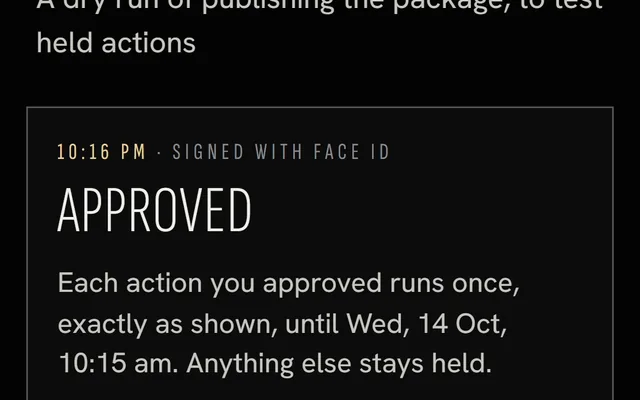
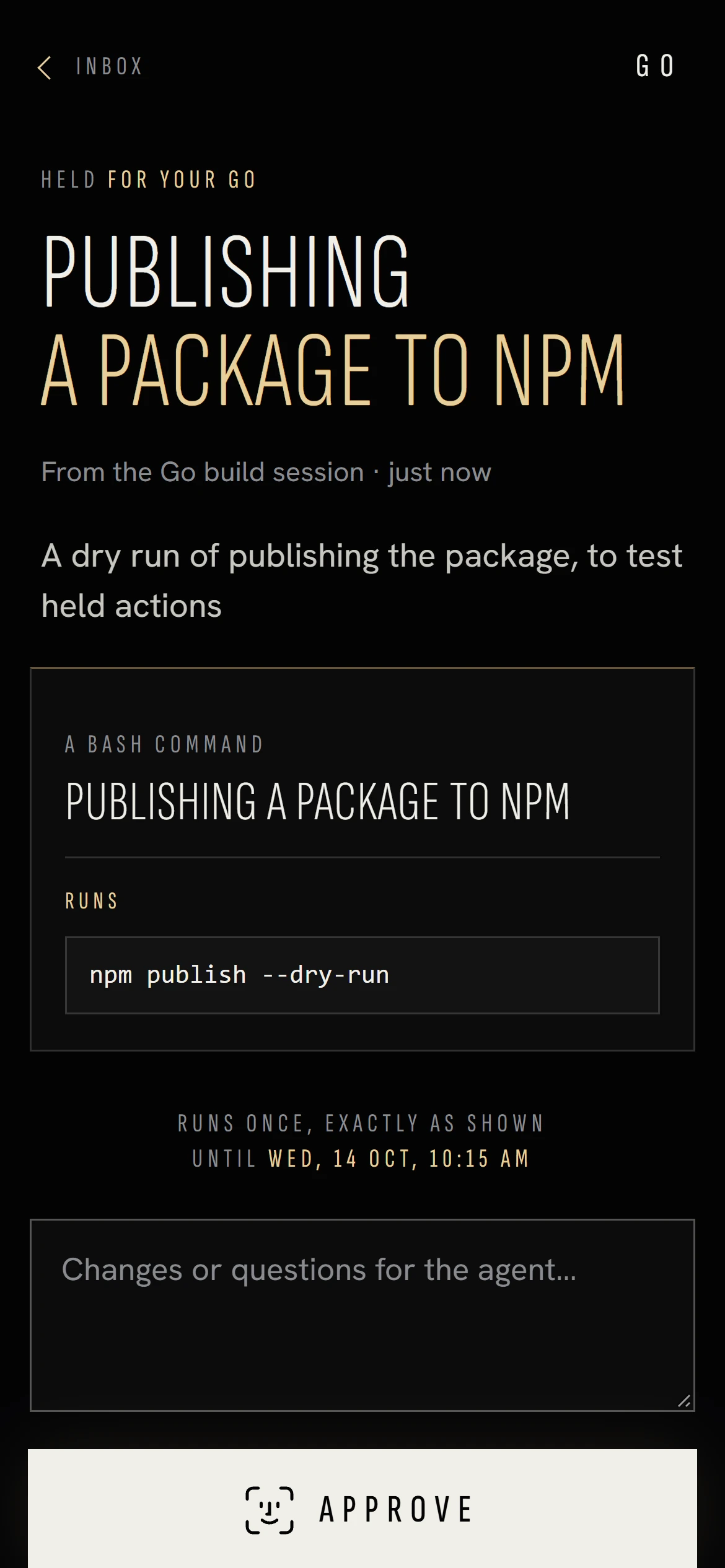
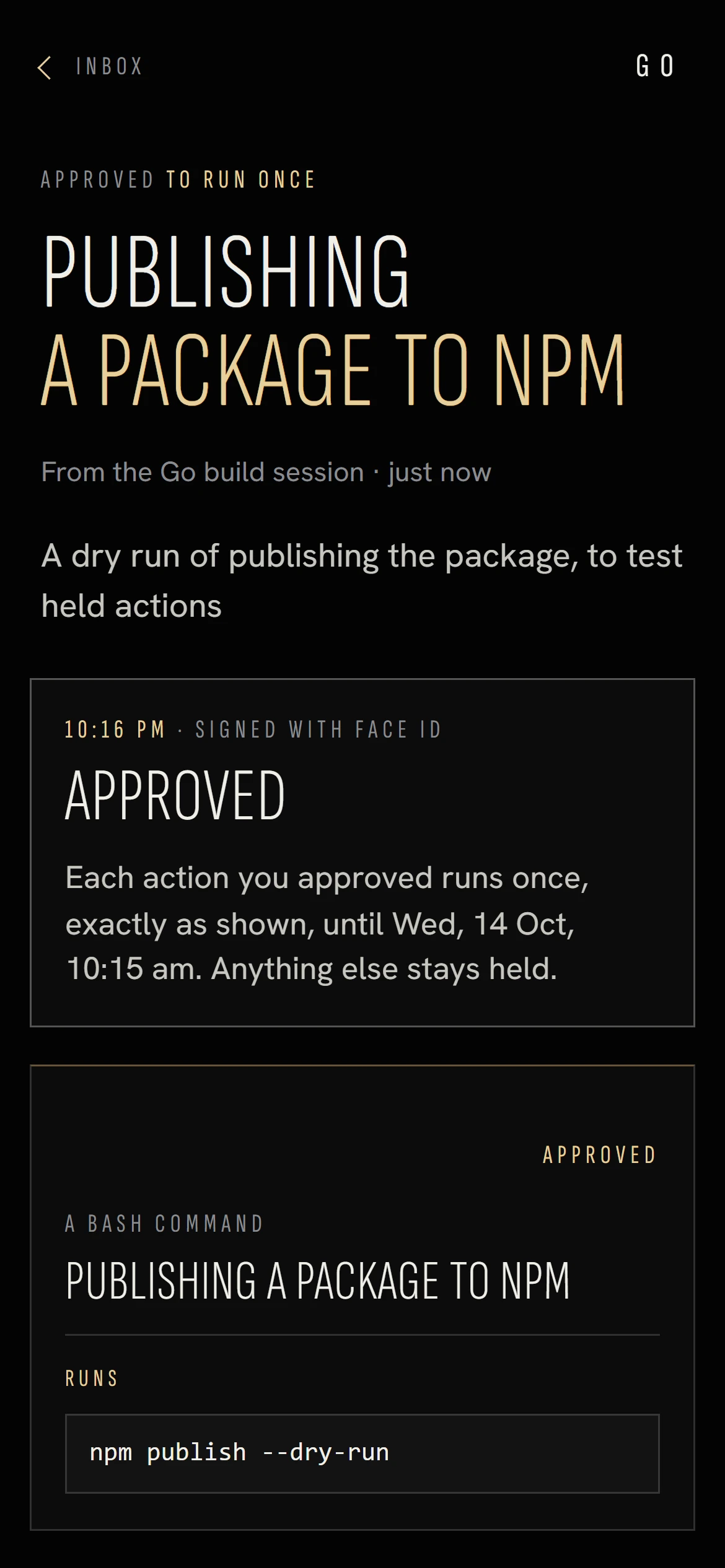
Go's own test of a held action, on my iPhone: an agent stopped before publishing a software package, waiting for my go. The card shows exactly what will run, and I can send the agent changes or questions instead of approving.Full size ↗
- Result
- One approval layer across my agents since 30 September 2026. In its first four weeks it held 726 actions, from emails sent as me to changes to the agents' core instructions, and I turned down or changed 35 of them. Since 13 October the approval can come from my phone with Face ID, locked to exactly what I saw, and repeat work runs under passes with a cap, an end date and a one-tap stop.
- My part
- All of it: the design (the system around the agents in place of rules in their instructions, a hold at the exact action, a yes that covers only that action, approvals locked to what I saw, passes for repeat work), every rule about what it holds, and the build of the gate and of Go.
- When
- The gate from 30 September 2026; Go live on 13 October; passes for repeat work from 22 October.
- Built with
- Claude Code hooks, with the same holds on my Gemini agents' instructions and settings; Go, a web app on my iPhone (Face ID passkeys and push notifications, reachable only from my phone over my private Tailscale network) with a Node.js server on my PC; gitleaks for the password check.
01 / 05
The problem with telling agents what needs approval
By the end of September 2026 my agents were building tools, sending things out and changing their own instructions, seven or eight of them at the same time. Their approval rules lived in those instructions, and I could see what that cost. They spent a lot of their reasoning working out whether they could or couldn't do something, thinking that should have gone into the work. The rules were ambiguous about when to check, so they over-asked. And with several agents changing their instructions at once, I had no clean way to gate them one by one.

A gate at the exact moment
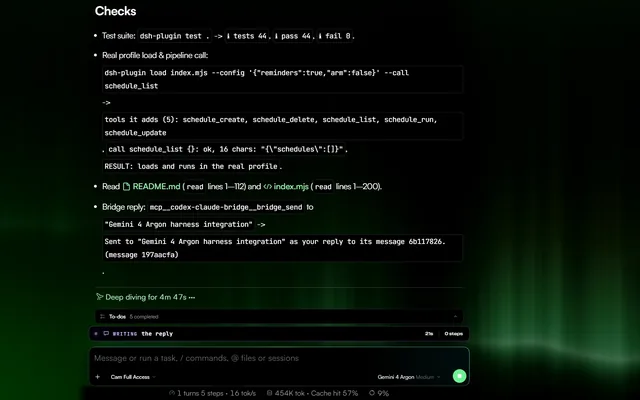
So I moved approvals out of the instructions and into the system around the agents: a gate that stops an agent at the exact moment that needs me, and nowhere else. It holds:
- an email sent as me, publishing anything or putting a change live, a delete, and a paid job on the services I've chosen to approve;
- a click in a desktop app that would send or post something as me;
- saving code with what looks like a password or key in it, or code that would take another agent's unfinished work in with its own;
- a change to the instructions every agent loads, their settings, or the gate itself.
It guards itself, too: changing the gate is one of the things it holds. And unlike a rule in an agent's instructions, it doesn't depend on the agent reading it right. My Gemini agents are held at the same points for their instructions and settings.
Everything else goes straight through. When an agent is held, it asks me, and because it was stopped at the action itself, it can show me exactly what I'm approving. That's why I chose a hold followed by a question: it tells me far more about what I'm saying yes to than an agent deciding for itself when to ask. My yes covers that exact action, once. If the agent changes anything about it, it's held again.
Not everything needs a hold. A week in, the approval requests had grown so wordy they buried what I was approving, so I had them rewritten plain and matched the gate to the stakes: the instructions every agent loads, their settings and the gate itself still wait for me, while their day-to-day files go straight in and a weekly review catches mistakes.
03 / 05
Approval from my phone
I also didn't want to be at my desk to keep things moving. So in October I built Go, an approvals app on my iPhone. When an agent is held and I've been away from the PC for ten minutes, the action comes to my phone as a card instead of waiting for me. I read it, approve with Face ID, and the agent carries on.
When I approve, Face ID signs the exact card in front of me, and nothing goes ahead until that signature checks out, so an approval can't be stretched to cover anything else. Only my iPhone can approve, over my own private network, and the agents have no way to approve anything themselves.
- An agent is held
- My phone
- Face ID
- The agent carries on
04 / 05
Passes for repeat work
Some work repeats, and I didn't want to approve it one item at a time. So repeat work can run under a pass: I sign its terms once (what it covers, a cap, the hours it runs and an end date), and one tap stops it. The first is for the agent that clears my inbox each night: it can move up to 60 emails a night to the deleted folder, 900 in all, until 20 November. Anything new still comes to me as a card.
05 / 05
What it has held
In its first four weeks the gate held 726 actions across my agents, and 35 times I said no, not yet, or to do it differently. One of them: an agent wanted to regenerate a film's shots with a paid video model. I had it show me the shots first and replace only the weakest, then try one or two on the new model before running the rest.
I run this on my own work every day. My agents don't spend their thinking on permission any more, and the actions I chose to hold, from an email in my name to a delete, wait until I've seen exactly what each one is and said yes, wherever I am. It's the control I'd build into a business before it lets AI act for it.