Cameron Tang
The meeting room in the model.

Level 2 · the meeting room · AI Briefing Engine

Expertise,
made usable.

I translated my expert-led creative briefing process into a guided AI product. The team can now prepare client briefs through the engine rather than returning each one to me.

Explore the demonstration →Case PDF ↓

MY ROLE
Workflow architecture, prompt design, user journey and creative handoff. The engineering team implemented the application.
OUTCOME
Client briefs moved from roughly one to two hours of my time to a team-operated process completed in minutes.
STATUS
In team use
Commercial workflow
Designed in late 2024

EXPERIENCE THE PROCESS

From a brief to
a shared direction.

Follow one speaker campaign through the decisions: compare concepts, review the scene plan, set the visual direction and carry it all into a storyboard handoff.

Explore the demonstration →Read the case PDF ↓

Redesigned experience with prepared content. This illustrates the process; it is not a capture of the shipped frontend.

01 / THE CONTEXT

In late 2024 I was turning a creative process I had developed through hands-on experimentation into a product others could use. The development emails show that learning in action: testing prompt output, simplifying client inputs and reshaping the workflow around the model's behaviour. The later team-use result demonstrates that the method became practical capability.

  1. Late 2024

    Workflow and prompt design

  2. December 2024

    Engineering implementation and iteration

  3. Subsequent team use

    Client briefing no longer depends on me

The business problem

Client briefing depended on me personally translating a business goal and source material into a creative direction, synopsis, script and proposed storyboard. Each brief required roughly one to two hours of my time.

The product needed to make that expertise usable by the team. It had to generate credible alternatives, let a person choose a direction, and preserve that choice as the brief developed into something the client and production team could use.

My contribution

I designed the architecture, user journey, AI prompt stages and creative handoffs from my own production process. I worked with Craig and the engineering team, who implemented the application.

02 / THE SYSTEM

Carry the choice forward.

From business intent to production handoff

  1. 01Business
    inputs
    Goal, audience, brand
  2. 02Concept
    options
    AI-guided development
  3. 03Human
    choice
    Creative directionHUMAN DECISION
  4. 04Script +
    storyboard
    Develop the chosen idea
  5. 05Human
    production
    Make the finished film
Design-level workflow. The finished film remains a separate production engagement.

INSIDE THE DESIGN

Give each decision the right information.

Explore three choices that shaped the briefing workflow.

LESS DETAIL. CLEARER ALTERNATIVES.

Make the next
decision easier.

Concise concepts let a person compare directions before the system develops scene-by-scene detail.

Business inputs→Concept alternatives→A human choice

03 / DESIGN & DELIVERY

The decisions that mattered.

01

Design around the next decision

An early synopsis response could contain extensive scene breakdowns and production detail before the client had even chosen a concept. I revised the prompts to make the alternatives concise and moved later-stage detail out of that decision.

I simplified the intake too. Broad brand descriptions needed room for the client's own words; defined choices such as duration needed to reach the model before it generated a synopsis.

02

Carry creative intent through the workflow

The concept names in the design specification were examples, not a fixed menu of ideas. I clarified that alternatives should respond to the client's information. The selected visual style then needed to carry into the storyboard image prompts.

I worked through the connections between these stages with engineering: when prompts should run, which information each needed, and how their outputs should appear in the interface. Those decisions were shaped by the Bedrock context, latency and streaming constraints we encountered.

03

What changed

The team now produces client briefs through the engine rather than sending each one back to me to create manually. The resulting synopsis, script and proposed storyboard support a client pitch and a production handoff. Making the finished film remains a separate engagement.

THE WORK / SOURCE EVIDENCE

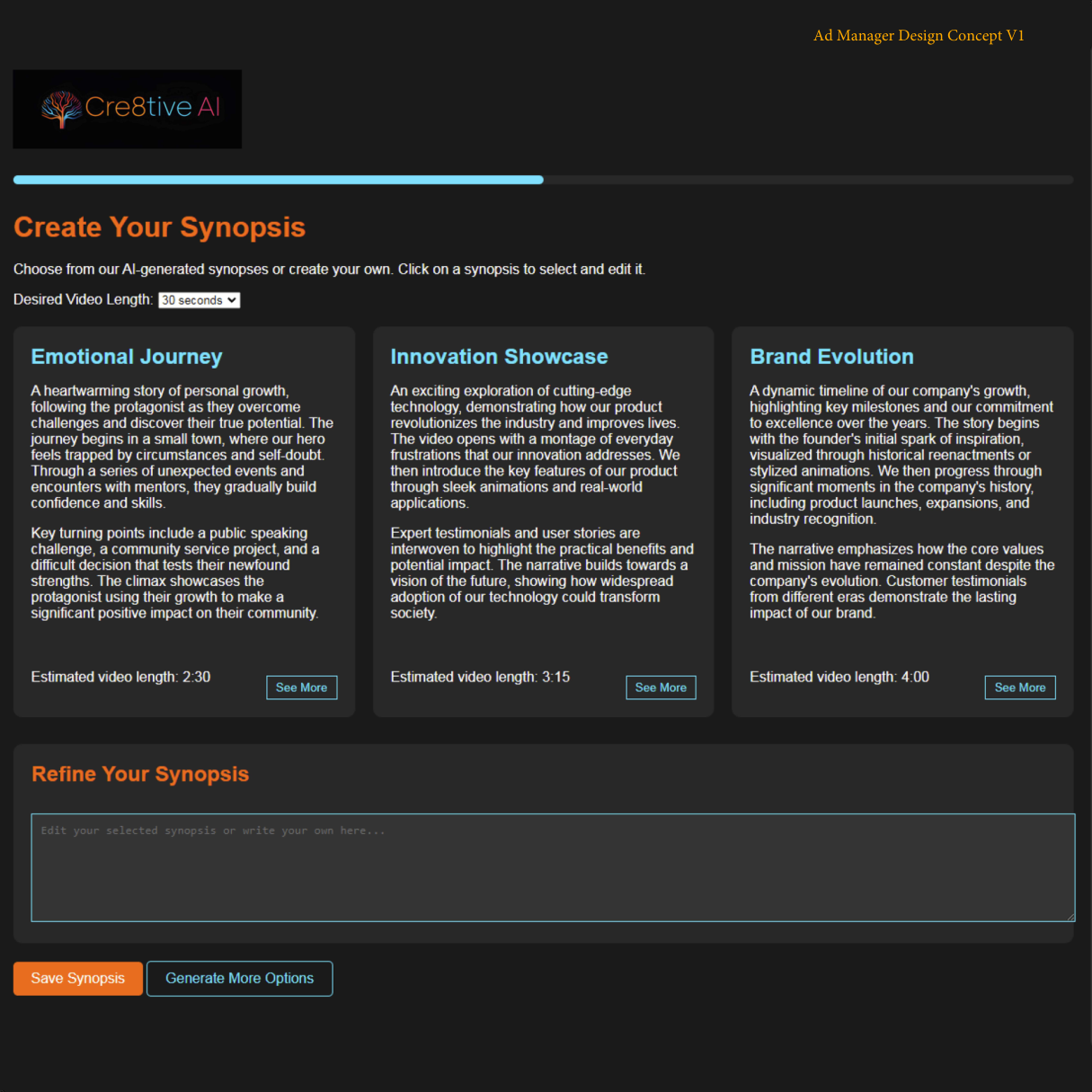
Original design specification

The synopsis-selection screen from the December 2024 design specification. The concept names on it are placeholders: I designed the engine to write its alternatives from each client's own brief.

Inspect full resolution ↗
Original design specification
Historical design artifact / December 2024
04 / WHAT THE WORK CHANGED

The accomplishment is turning an expert-dependent service into a practical capability other people can use, while preserving the decisions that still need creative and client judgement.

Public product entry

An account is required to begin a brief.

Open source ↗

Development record

December 2024 correspondence and original design specification.

Operating outcome

Since it launched, I haven't had to make a brief by hand. By March 2026, 149 briefs had been run through it from 20 different accounts, and Cre8tive AI still uses it in production.

Case PDF ↓Home →